Water Features and Surface Design: Planning a Cohesive Pool Renovation in Oviedo and Lake Nona
A pool renovation looks simple on paper. New finish, updated tile, maybe a water feature, maybe lights. Then the real questions start. Does the new spillway fit the shape of the pool, or does it feel added on? Will the finish color fight with the coping? Will the deck texture make the whole space feel calm and unified, or busy and patched together?
That is where many remodels either come together beautifully or start to feel pieced together.
Homeowners in Oviedo and Lake Nona often begin with one practical need, usually worn plaster, faded tile, or aging equipment, then realize the pool deserves a larger design conversation. Once you resurface, every adjacent material becomes more noticeable. The old waterline tile that once blended into the background suddenly looks tired. A deck that felt acceptable before can seem disconnected next to a fresh interior. New lights can make a dated finish look worse at night, not better.
A cohesive renovation is not about adding more features. It is about making each visible surface and each moving part feel intentional together.
Why water features and finishes need to be planned as one system
Pool owners often think in categories. Interior finish. Tile. Coping. Deck. Lighting. Water feature. Permits. HOA approval. Scheduling. In real life, those categories overlap every day on the jobsite.
A raised wall with a scupper changes the visual center of the yard. That means the tile line, finish color, and deck tone all need to support it. A darker interior finish can make a shallow tanning ledge read more dramatically in sunlight, but that same finish may reflect differently once pool lighting upgrades are installed. A textured deck may feel good underfoot, but if its pattern is too active, it can compete with a decorative tile band and turn the whole poolscape noisy.
In places like Oviedo and Lake Nona, where homeowners often want a clean, polished outdoor look, the most successful renovations usually come from restraint. Not plainness, just restraint. One strong focal point tends to outperform three competing ones.
That matters whether the project is a full pool renovation Lake Nona homeowners have been postponing for years, or a more targeted update centered on pool finishes Oviedo families want before another Florida summer.
Start with the view from the house
Before anyone talks materials, it helps to stand inside the home and look outward. The most important pool view is usually not from the pool deck. It is from the kitchen, family room, covered lanai, or primary bedroom.
That perspective tells you what actually needs emphasis. If the pool is mostly seen from twenty feet away through large glass doors, broad color relationships matter more than tiny decorative details. If the raised spa is visible from the main gathering area, it may deserve the strongest tile statement. If the yard is compact, oversized features can make the whole renovation feel cramped, even if each individual selection is attractive on its own.
This is also where many surface decisions become easier. If the home already has warm pavers, creamy trim, and a soft neutral exterior, a cool blue-gray finish with a stark white coping can feel disconnected. Not wrong in isolation, just disconnected. On the other hand, a home with sharp contemporary lines may benefit from cleaner contrast and a more controlled material palette.
When I have seen renovations age well visually, the owners usually made one smart choice early. They decided what the pool should feel like before deciding what the pool should include.
The finish sets the tone more than people expect
The pool interior is not just a maintenance surface. It is the visual body of the water. Everything else frames it.
That is why resurfacing decisions carry so much weight. Even when a code document treats resurfacing to original nontoxic, slip-resistant, smooth specifications, or equivalent replacement, differently from a larger modification in that context, the design effect can still be dramatic. A new interior changes the way the entire yard reads.
For homeowners comparing options around pool resurfacing Windermere FL, pool resurfacing Sanford FL, or an Orlando area pool renovation closer to Oviedo or Lake Nona, the common mistake is choosing a finish from a small sample without checking it against the existing deck, coping, and tile in outdoor light. A sample board can hint at texture, but not at how the water will look at noon, late afternoon, or after dark with lights on.
A finish that appears soft and neutral in a showroom can read much darker once the pool is full. A finish with noticeable aggregate may catch light beautifully, but it may also push the pool style toward a more dramatic look than the homeowner intended. Neither outcome is automatically good or bad. The point is that surface choice sets the emotional temperature of the entire renovation.
In Oviedo, where many homeowners want a comfortable, lived-in elegance rather than a resort-style showpiece, that often means keeping the interior finish as the anchor and letting tile, lighting, and water movement play supporting roles.
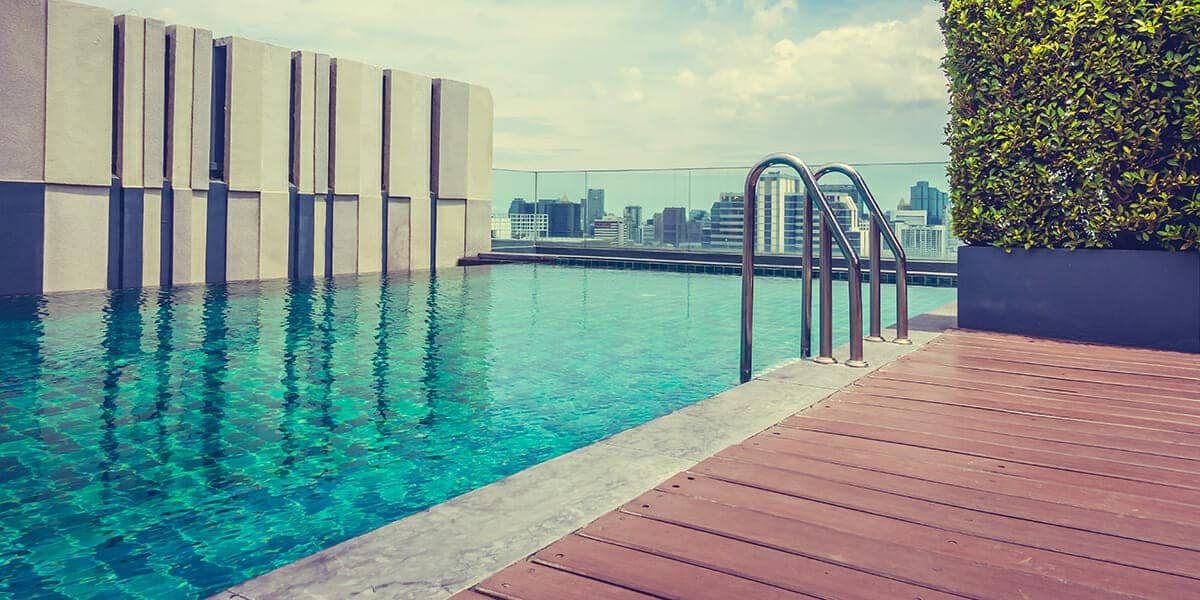
Water features work best when they respect the pool’s geometry
Water features add sound, motion, and identity. They can also quickly become the reason a renovation looks overdesigned.
The best water feature is usually the one that feels like it belongs to the original pool shape. On a simple rectangular pool, a clean spillway or a modest raised wall can make sense because it echoes the geometry. On a freeform pool, a rigid linear feature may feel forced unless the surrounding architecture already has strong straight lines.
This is where homeowners sometimes get caught by inspiration photos. A feature that looks striking in one backyard may not fit another yard’s scale, architecture, or viewing angles. A narrow lot, a screen enclosure, nearby seating, or an existing deck layout can all change what feels appropriate.
In practical terms, cohesive design often comes from answering a few plain questions:
- Is the water feature meant to create sound, create a focal point, or hide an awkward visual area?
- Will it be viewed straight on, from an angle, or mostly from inside the house?
- Does the feature require finishes or tile selections that introduce a second design language?
- Will added lighting highlight the feature in a flattering way at night?
- If the feature were removed from the plan, would the renovation still feel complete?
That last question is a useful test. If the answer is no, the feature may be carrying too much of the project. If the answer is yes, then adding it becomes a choice, not a rescue.
Tile should connect surfaces, not compete with them
A lot of pool tile design ideas look exciting in isolation. The challenge is that pool tile lives next to reflective water, textured decking, coping edges, and often the vertical face of a spa or wall. The busier the tile, the less room there is for everything else.
For most remodels, tile succeeds when it acts as a bridge between surfaces. It can tie the house color to the water tone. It can soften the transition between coping and finish. It can bring a small accent to a raised wall without demanding full attention.
When clients push toward multiple decorative elements at once, I usually think view the page in terms of visual hierarchy. If the tile has variation, let the deck stay quieter. If the deck has strong pattern or color movement, simplify the tile. If the water feature is architectural, avoid making the tile too ornate.
This matters even more in renovations that are not fully rebuilding the shell, but updating visible finishes around existing bones. In projects resembling pool remodeling Dr. Phillips or Altamonte Springs pool remodeling work, the strongest design decisions are often the ones that respect what is already there and improve its clarity rather than trying to disguise it with layers of ornament.
The deck is not background, even when people treat it that way
Homeowners are sometimes willing to spend heavily on tile and finish, then treat the deck as an afterthought. That is a mistake, because the deck occupies the largest visual field around the water and has direct impact on comfort and safety.
Texture under bare feet matters. Heat absorption matters. Drainage matters. The way the deck meets the coping matters. If the deck is being altered as part of the renovation, those details should be considered early, not after finish and tile have been selected.
Local permit submittals for residential pool or spa work in Orlando can involve site plans or surveys and details that account for drainage, existing conditions, easements, distances to property lines, and nearby improvements. That is a reminder that surface design is never only aesthetic. Once you change areas around the pool, practical site considerations are part of the conversation.
A beautiful material can still be the wrong choice if it creates awkward transitions, traps water, or clashes with nearby structures. In Central Florida’s warm rainy season, where frequent showers, thunderstorms, high humidity, and summer heat are routine, surface performance deserves as much respect as surface appearance. Even later in the year, heat and humidity can linger, and weather patterns can remain disruptive. Renovation schedules and material planning should reflect that reality.
Lighting reveals whether the renovation is truly cohesive
A pool can look coordinated at noon and disjointed at 8:30 p.m. That is why pool lighting upgrades deserve design attention, not just technical attention.
Light changes color perception. It sharpens some textures and flattens others. It can make a calm finish shimmer or make a highly variegated tile look restless. It can also shift the focus toward the water feature, the shallow end, the spa, or the perimeter, depending on placement and intensity.
Many homeowners think of lighting late in the process. By then, they have already selected materials that may or may not respond well after dark. Better results come when lighting is discussed while choosing finish and tile, not afterward.
Night use also changes the priorities. A family that swims mostly in the evening may want a softer, more balanced glow rather than dramatic spotlighting. A homeowner who entertains outdoors may prefer the water feature to hold the eye from the lanai, with less emphasis on the far edge of the pool. There is no universal right answer. The key is to understand that lighting exposes mismatches very quickly.
Permits, separate scopes, and the trouble with “while we’re at it”
Many renovations expand one small decision at a time. A resurfacing job turns into tile replacement. Then someone suggests adding a bubbler or a raised wall. Then the homeowner decides to upgrade lighting, revise the deck, or add a screen enclosure adjustment.
That can be fine, but it changes the project’s path.
Typical residential pool or spa work in Orlando commonly involves building and electrical permits, and sometimes plumbing or gas permits. Separate permits may also be required for items such as screen enclosures, gas piping, solar, and fencing. Final inspections can involve items like the pool deck, pump, and child barrier. Safety barriers and gate requirements remain part of the picture. And if you live in a neighborhood with design controls, HOA review may matter too.
This is where design discipline helps. The more clearly the renovation is defined on the front end, the easier it is to coordinate scope, approvals, and inspections. It also helps avoid the familiar problem where a homeowner starts with “just pool finishes Oviedo” and ends up halfway into a much larger project without realizing how many connected decisions are involved.
For some communities, HOA pool resurfacing review can be every bit as important to scheduling as municipal review. Material colors, wall heights, or visible exterior changes may trigger neighborhood-level questions even when the homeowner assumes the work is straightforward.
A cohesive renovation usually solves these conflicts early
Most disappointing remodels do not fail because one material was bad. They fail because several decisions were individually acceptable and collectively inconsistent.
Here are the conflicts worth catching before work begins:
- A dramatic tile paired with a dramatic finish, leaving no visual resting place
- A sleek water feature attached to a pool and patio with softer, more traditional lines
- A deck update that ignores drainage or transition details around existing improvements
- New lights that exaggerate color differences the homeowner did not notice in daylight
- Scope creep that adds permit or HOA complications late in the process
None of these are rare. They are standard renovation problems. The upside is that they are usually preventable with better sequencing and clearer priorities.
Sequencing matters more than style boards
People love finish samples and inspiration images. They are useful, but they do not replace sequence. Good renovation planning tends to move in a logical order.
First, define the real goal. Is this mainly about renewing the shell, modernizing the look, improving night use, or making the pool area feel more connected to the home? Once that is clear, evaluate what must stay and what can change. Existing deck areas, property line constraints, drainage conditions, barriers, and nearby structures can all limit what makes sense. After that, select the interior finish because it drives the water’s character. Then choose tile and coping that support it. Finally, confirm how lighting and any water feature will affect those selections in real use.
That order sounds simple, but many homeowners reverse it. They fall in love with a water feature or a tile pattern first, then try to force the rest of the renovation around it. Sometimes that works. More often, it produces compromise after compromise.
Renovating for the neighborhood without copying it
In communities around Lake Nona, Oviedo, Windermere, Sanford, Dr. Phillips, and Altamonte Springs, homeowners often want their backyard to feel current without looking borrowed from someone else’s listing photos.
That balance matters. You want the renovation to fit the home and the neighborhood, but not lose its own identity. The cleanest way to do that is to pay attention to proportion and material relationships instead of chasing novelty. A quieter palette with one well-placed focal feature usually holds up better over time than a collection of trendy statements.
This is especially true if the renovation is part of a larger Orlando area pool renovation strategy that may unfold in phases. If lighting, deck updates, or adjacent outdoor living improvements might happen later, the pool itself should be designed with enough discipline that future changes can plug into it without starting over visually.

A resurfacing project can absolutely be modest and still feel complete. A more extensive remodel can absolutely include a water feature and upgraded tile without becoming busy. The difference is usually not budget. It is editing.
The best pool renovations feel inevitable when they are finished
When a pool renovation really works, the result does not scream for attention. It feels settled. The water color suits the home. The tile makes sense. The deck supports everything around it. The lighting is flattering instead of theatrical. The water feature, if there is one, seems like it was always meant to be there.
That kind of result comes from patient decisions made in the right order.
If you are planning pool resurfacing Windermere FL, comparing pool resurfacing Sanford FL options, considering pool remodeling Dr. Phillips, or mapping out a pool renovation Lake Nona or pool finishes Oviedo project, it helps to think beyond the immediate repair or finish change. Ask how each new surface will look next to the next one. Ask what the pool should feel like from inside the house, in midday sun, and after dark. Ask whether the feature you want is enhancing the pool’s architecture or distracting from it.
Most of all, respect the project as both a design exercise and a real construction process. Permits, separate scopes, site plans, drainage considerations, barriers, inspections, and possible HOA pool resurfacing review are not side notes. They are part of what makes a polished renovation possible.
A cohesive pool renovation is never just about replacing what is worn out. It is about making the water, the surfaces, and the surrounding space speak the same language. When they do, the whole backyard gets quieter, stronger, and easier to enjoy.